

J Kumar-NCC JV Begins Assembling TBMs for Mumbai’s GMLR Tunnels
J Kumar Infraprojects – NCC JV in mid-March began assembly works for the first of two Terratec tunnel boring machines (TBMs) of Mumbai’s 12.20 km Goregaon-Mulund Link Road (GMLR) project.
When commissioned, these 14.42m diameter rock EPB machines for Phase IIIB of the GMLR project by Brihanmumbai Municipal Corporation (BMC) will be the largest ever deployed in India. Each mega TBM will bore 5.3 km in a single drive to build twin tunnels with a finished internal diameter of 13,000mm.
The project’s launch shaft (view on Google Maps) measuring 100m long, 50m wide and 35m deep is located in Goregaon’s Dadasaheb Phalke Chitranagari area – officially known as Film City. The first major component of the TBM was lowered on to its cradle on March 11 using cranes with capacities of 800 metric tonnes and 350 metric tonnes.
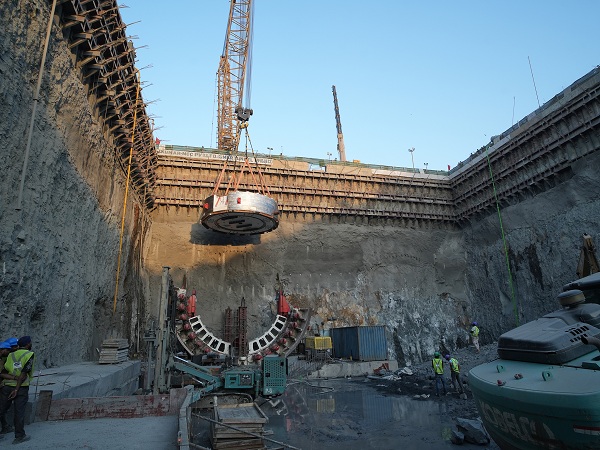
A cool video posted of the ceremony posted by BMC with views of the shaft can be viewed here on X.
6.62 km long Phase IIIB of GMLR involves the construction of 5.3 km twin road tunnels connecting Film City in Goregaon East to Amar Nagar in Mulund West forming an east-west link passing beneath Sanjay Gandhi National Park. Its Detailed Project Report (DPR) and alignment options were prepared by PADECO India.

BMC had awarded J Kumar – NCC Pvt. Ltd. with the project’s Rs. 6301.08 crore contract in September 2023. Factory acceptance tests (FAT) for the first TBM was completed at Terratec’s facility in Thailand in January 2025, and parts of it started arriving in Mumbai in July 2025.
Satellite imagery of the TBM’s parts stored roughly 250m west of the launch shaft can be viewed on Google Maps over here.


Per Terratec’s press release, the machines are designed for the project’s demanding geological and hydrological conditions, with the alignment passing through Deccan basalt and breccia formations at maximum overburden depths of 143m and potential high working water pressures.
Each machine features two screw conveyors, a fourth-row tail brush seal, twin probe drilling for advance treatment of high water inflows, and additional dewatering systems. Excavated material will be removed via TERRATEC’s tunnel continuous conveyor and overland conveyor system, with segment transport handled by MSVs along the alignment’s -1.1% downward gradient.


TYPSA is serving as the project’s Project Management Consultant (PMC).
Coming back to size, as I mentioned above, these mega TBMs will be the largest to be deployed in India. The machines for the 508.17 km Mumbai – Ahmedabad High Speed Rail project’s underground section in Mumbai have a 13.56 km diameter, while Mumbai’s Coastal Road project saw one 12.19m diameter slurry TBM, named Mavala, getting deployed to build two tunnels between 2021-2023.
GMLR project is estimated to cut down the travel time between Mulund and Goregaon from over an hour (depending on day & time) to 20 mins. This will be the second tunnel project under SGNP after the 11.84 km Thane – Borivali twin tunnel project further up north.
For more updates, check out the Tunnels section or my Home Page! Sign up for free instant email notifications on new posts over here. Like this post? Get early-access to updates and support the site over here.
– TMRG



Leave a Reply
Want to join the discussion?Feel free to contribute!